
Every entrepreneur has a version of the same story. Mine is simply more expensive than most.
For twenty years I built marketing and revenue systems for other people's companies, and for my own. I was good at the systems. I was bad at one thing, and that one thing undid more of my work than any competitor, market crash or regulation ever did: I trusted the wrong people, and I did it on my own collateral.
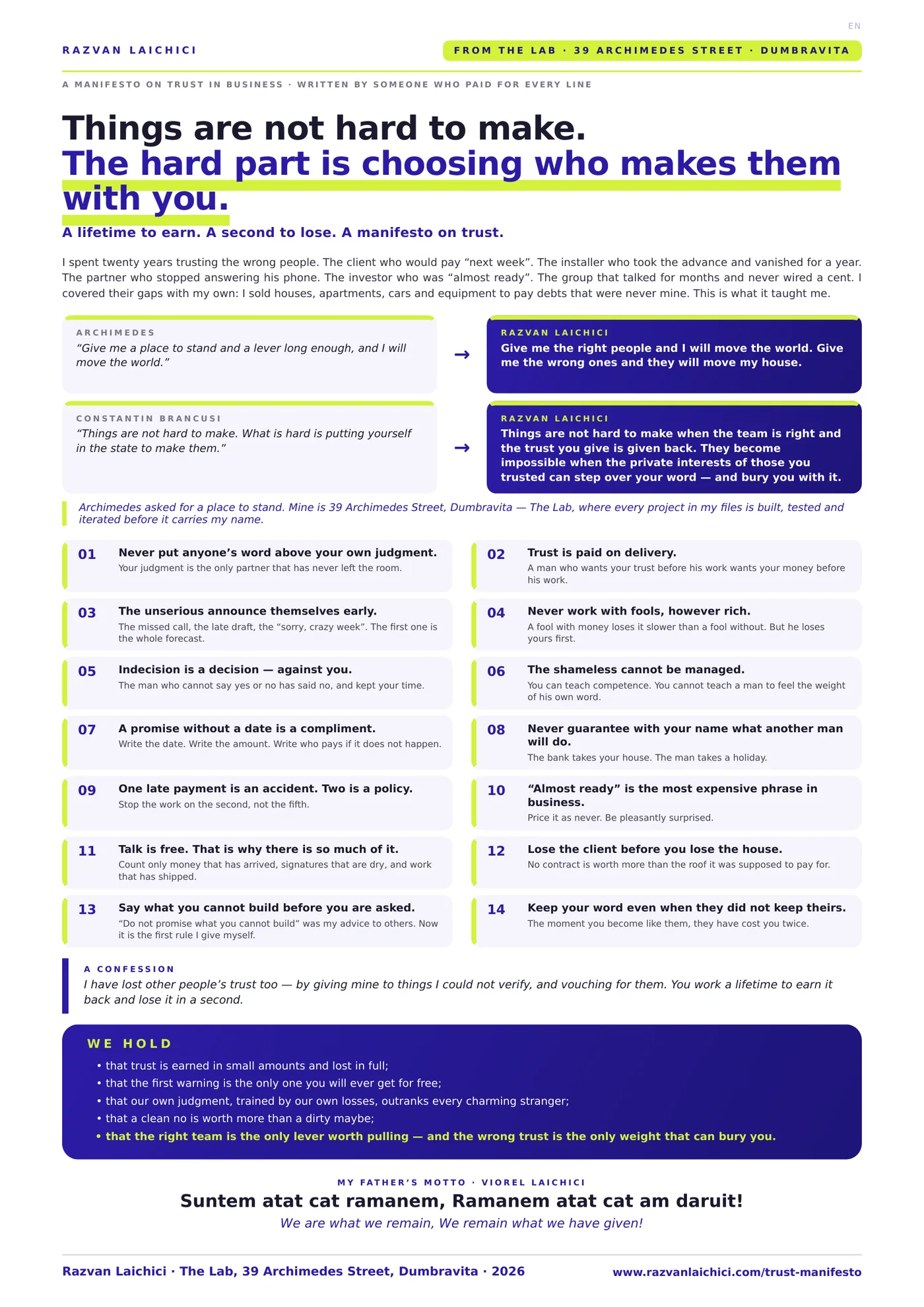
This article is the long version of the poster that sits next to it. The poster is for your wall. This is for the evening when you are about to wire an advance, sign a guarantee, or take a man's word for it, and something in you hesitates. Read this first.
The holes
I will not name anyone. The names do not matter; the patterns do, because the patterns repeat.
There was the client who would pay "next week". He paid next week for eleven months, which is to say he never paid, and my companies carried the equipment leases, the operating leases and the telecom contracts that his orders had justified. When he stopped answering, the contracts did not.
There was the installer who took the advance, said all the right things about certification and lead times, and delivered nothing for more than a year. There was the partner who held half of a company and simply left the country, unreachable, so that closing a two-hundred-lei SRL took three general meetings and eight weeks of lawyers. There was the intermediary everyone said was "the way in", until the platform behind him said no and the months were gone. There was the group that met, talked, planned and promised, and never wired a cent to anyone. There was the firm that installed a smart-home system in my house and went bankrupt, taking the project files with it.
None of these people were villains in their own story. Most were simply unserious, or undecided, or unable to feel the weight of their own word. The result was the same. I covered their gaps with my own. I sold houses. I sold apartments. I sold cars and equipment. I paid debts that were never mine so that my name would still mean something when the dust settled.
It does. That is the only reason I can write this.
What a lever taught me
I live and work on a street named after Archimedes, and I have come to take that personally.
Archimedes said: give me a place to stand and a lever long enough, and I will move the world. Every founder reads that sentence as a promise about leverage — capital, technology, distribution. I read it differently now. The sentence has two parts, and everyone forgets the first. A place to stand. The lever is useless if the ground under your feet is somebody else's promise.
My own version is shorter: Give me the right people and I will move the world. Give me the wrong ones and they will move my house.
A lever amplifies whatever you put on it. The right partner amplifies your work. The wrong one amplifies your exposure. Trust, in business, is the decision about where you set the fulcrum — and you only get to set it once per deal.
Brancusi, reversed
Constantin Brancusi, the Romanian who taught the twentieth century what a sculpture could be, said that things are not hard to make; what is hard is putting yourself in the state to make them. I have carried that sentence for years. It is true of every product, every campaign, every site I have ever built.
But I have earned the right to add a second half to it.
Things are not hard to make when the team is right and the trust you give is given back. They become impossible when the private interests of those you trusted can step over your word — and bury you with it.
The state Brancusi talks about is internal. The second condition is external, and it is the one nobody teaches. You can be in a perfect state to build and still be buried, because the man holding the other end of the beam decided his interest outranked his word. The manifesto is my attempt to make that second condition teachable.
The fourteen rules, and what they are really about
The poster carries fourteen rules. I will not repeat them all here; read them on the wall. But I want to say what they have in common, because the rules are consequences and the principle is the point.
The principle is this: never put anyone's word above your own judgment. Not a charming investor's, not a rich fool's, not a friend's, not an expert's. Your judgment is the only partner that has never left the room. Everything else in the manifesto is that sentence applied to a situation.
Trust is paid on delivery — because a man who wants your trust before his work wants your money before his work.
The unserious announce themselves early — because the first missed call is not an exception, it is the forecast. I used to forgive the first one. Now I write it down.
Never work with fools, however rich — because a fool with money loses it more slowly than a fool without, but he loses yours first. I have watched it happen with money that was not his and a house that was mine.
Indecision is a decision, against you — because the man who cannot say yes or no has already said no, and kept your time.
The shameless cannot be managed — you can teach competence; you cannot teach a person to feel the weight of his own word.
Never guarantee with your own name what another man will do — because the bank takes your house, and the man takes a holiday. This is the rule I paid most for. It is the one I would tattoo on the inside of every founder's eyelids.
One late payment is an accident; two is a policy — stop the work on the second, not the fifth. Every hole I have ever fallen into had a fifth.
"Almost ready" is the most expensive phrase in business — price it as never, and be pleasantly surprised.
Lose the client before you lose the house. No contract is worth more than the roof it was supposed to pay for. I know, because I have traded the roof for the contract, and the contract did not keep the rain out.
And the last two, which are about me, not them: say what you cannot build before you are asked, and keep your word even when they did not keep theirs. The moment you become like them, they have cost you twice.
A confession
It would be dishonest to write all this as if trust were only something other people broke.
I have lost other people's trust too — by giving mine to things I could not verify, and vouching for them. I introduced people to partners who turned out to be unserious. I put my name next to timelines that other men were supposed to keep. When they failed, my name failed with them, in rooms I was not in.
You work a lifetime to earn it back and lose it in a second. That is not a complaint. It is the strongest argument for the manifesto: the cheapest way to protect the trust people place in you is to be brutally selective about where you place yours.
The Lab
The address at the top of this page is not decoration.
39 Archimedes Street in Dumbravita is where I build. The battery rooms, the solar tables, the containers, the compute prototypes, the smart-home systems, the content engine — everything in my portfolio was assembled, tested and iterated there before it carried my name. I call it The Lab because that is what it is: the place where a thing has to work in front of me before I will say it works in front of you.
That, too, is a trust rule. I do not ask people to believe my slides. I ask them to come and see the meter.
My father's motto
My father, Viorel, left me one sentence. I do not translate it loosely and I do not lend it to any company, not even my own. It belongs to the family and to the materials I sign personally:
Suntem atat cat ramanem, Ramanem atat cat am daruit! We are what we remain, We remain what we have given!
For years I read it as a sentence about generosity, and it is. But after the holes, I read the first half differently. We are what we remain. What remained of me, after the houses and the cars, was the part that nobody could take: the judgment, the word, the work. That is the part the manifesto is written to protect — so that what you give is given from strength, by choice, to people who give it back, and not lent away to those who never intended to return it.
What to do with this
Print the poster. Put it where you sign things.
Before the next advance, the next guarantee, the next "almost ready", read rule eight and rule nine out loud. If you still want to proceed, proceed — with a date, an amount, and a name for who pays if it does not happen.
And if you recognised yourself in the first half of this article rather than the second — if you have been the client who pays next week, the partner who stopped answering — you already know what to do. The lever works in both directions. So does the word.
Razvan Laichici is the founder of Webness and ContentSystemOS and co-founder and Chief Marketing Officer of the TerranOS platform. He writes from The Lab, 39 Archimedes Street, Dumbravita. The Trust Manifesto poster, in English and Romanian, is at www.razvanlaichici.com/trust-manifesto.